

Working, Leading and Eating Sushi
What the Sushi Train Can Teach Us About Leadership

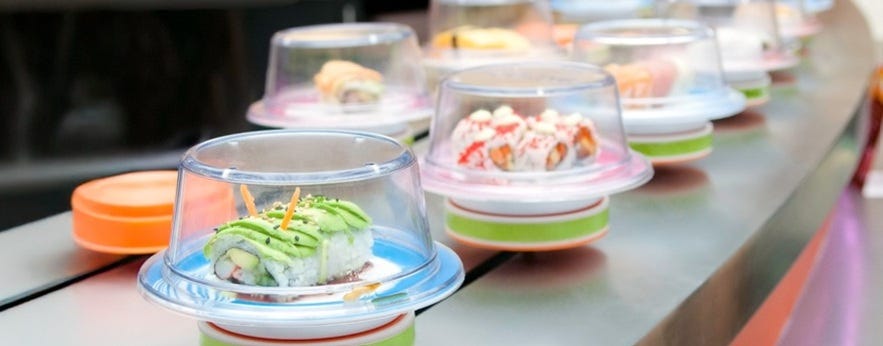
I’ll admit it, I love the sushi train. Maybe some of you do too? But this article isn’t really about sushi. It’s a metaphor for work and leadership.
In my work as a facilitator and coach, people often ask me how they can be more of something or less of something else. I ask myself the same questions too. In the past, I might have worked with a variety of methods and tools. The focus of these would mostly be along the lines of exploring strengths, concerns, desires, thinking and attitude.
The end result would always lead to some edge, whether practical or esoteric. The conversation would usually entail the need for some change. And let’s be honest, change can be hard. We might accept at this point that we need to do some painful work and perhaps we embark on a ‘change’ journey. Sometimes successful, often not.
What if I told you there was another way to pursue what you want with less effort and more ease?
We all play different roles in life
There are the formal roles: your job, your family role (mum, dad, sibling), or social roles (friend, neighbour). Then there are the informal roles: the serious one, the curious one, the clown, the peacemaker, the troublemaker.
In each role, we behave a little differently. For example, if you were called to court as a witness, you probably wouldn’t show up as the clown. You’d bring the diligent one. You could change your behaviour very quickly, without needing to change who you are, and so meet the need of the current situation with the desired behaviour.
In life, we are constantly picking up and putting down roles. Most of the roles we take up don’t come with a manual or training. We figure them out by listening to our values, watching others, and picking up cues. We form habits around how we inhabit roles. This is something we tend to do without much thought. We are very well practised in role fluidity without that necessarily being conscious knowledge. We can easily miss that role fluidity is a resource we already own, for change.
Every role has a cost and a benefit
When the sushi train rolls around, every dish has a different coloured plate indicating the price. Some use this as their guide, some people only take the meals that look familiar to them, what the person they are with chooses or they choose out of habit. Others go with what looks interesting or even unfamiliar. Everyone does it a bit differently. What we can say is that everything we choose has costs and benefits.
In life, we get to choose what roles we take up and how we inhabit them. Over time, we the way we take up roles becomes automatic and we can lose sight of just how much choice we actually have. Sometimes we grab something we didn’t even really want, possibly from habit, or maybe because we felt pressure, from ourselves, from others, from society? Like the sushi we choose, roles have costs and benefits.
The reluctant kitchen cleaner
Take this classic workplace example: the person who always ends up cleaning the work kitchen.
“Why is it always me? Why can’t people clean up after themselves?”
They’ve taken a dish they didn’t want. And now they are paying for it, maybe with resentment, exhaustion, or just that nagging feeling of being unappreciated. But they seem compelled to do it anyway, not seeing the invisible, gravity-like pull that keeps them returning to the role.
When we slow things down and examine them more closely, we become aware of the choice on offer. This small act of perspective-shifting opens the possibility that we have more choice than we realised, and new possibilities can emerge.
Learning to say no to unwanted roles
When someone tries to hand us a role we don’t want, for example, “You’re always the reliable one, you do the minutes,” we can learn to spot that in real time and practise declining it, politely and firmly, we are not obliged to take it personally, it’s a role we are offered and one which we choose not to take.
You might experience this in other ways; a very common one is in meetings. Meetings present an opportunity to demonstrate leadership as well as public failure. We can self-edit and decide to stay silent rather than risk being judged. We might head for safety, and later we may justify it to ourselves by saying it wasn’t the right time or some other excuse, convincing ourselves it was a strategic disengagement.
The clue is that after the meeting we are still somehow bothered by what we did or didn’t do. By being deeply honest, we can see that we were avoiding the risk of some psychological pain, appearing stupid, challenging authority, or being judged in some way, shape or form. This is different to a conscious tactic around timing.
Ask “What is my role here?”
In this context, what often stops us is our learned habit of making the action we take, and perceived ‘failure’, a personal risk to be avoided. A shift is to ask ourselves, “What is my role here?” Role can aid and authorise us to take action when we fear for our ‘safety’. Role is always connected to a bigger purpose. Purpose helps us vault past our own need for safety and security, which can be the enemy of greatness.
Change the script, not the self
If there is something you want to change about yourself, try this: don’t focus on changing who you are. Look at the role.
Which behaviours support that role?
Which ones don’t?
Select the role for yourself, fully. Align to the purpose of the role, make that the focus.
Change the script, not the self.
Remember the sushi train
So next time you’re at work, remember the sushi train. Identify what is truly on offer. Remember you have more choice than you think. You already own the skill set of role fluidity, you do it every day. Changing behaviour in the context of role is easier than trying to change yourself.
Choose how you want to show up using role and purpose as your guide. Take the role you want. You won’t end up feeling resentful or compelled to act a certain way, feel trapped and powerless, or feel bad and decide you need to change yourself.
Instead, examine the conditions of the system and choose the way you want to take up your role in service of the purpose. Experience the liberation that comes from working fully in role.
This article is written by Peta Bayman - AI edited not generated.